
Probably Stolen water grades, contamination types, test strips, filters, tablets, UV, purifiers and a repeatable workflow for selling clean water.
Probably Stolen Water Guide: Grades and Purification
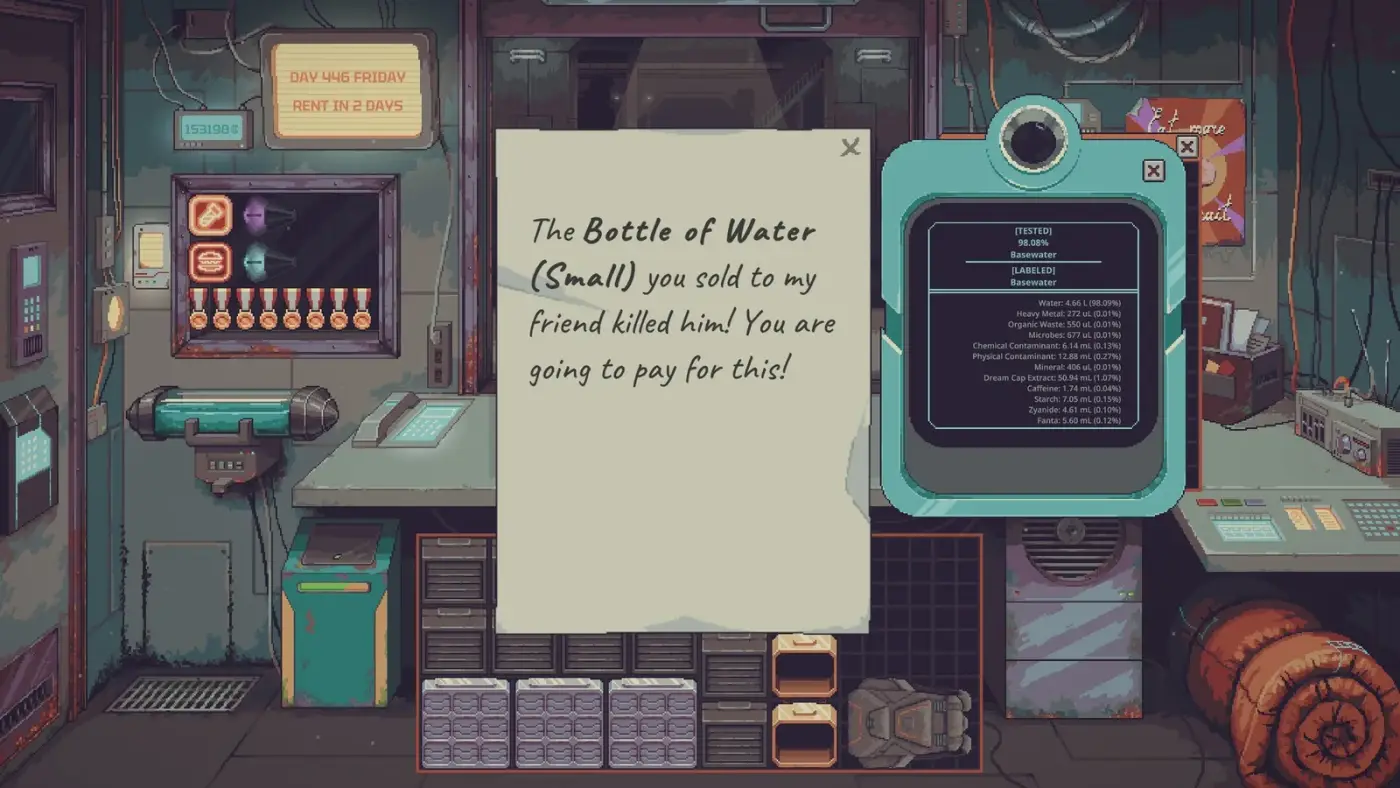
Water is the safest product in Probably Stolen and the easiest one to ruin. It is cheap, everyone needs it, and a dirty bottle can kill a customer. The game does not hide this: a complaint letter in the shop explicitly says a bottle you sold killed the buyer's friend. That is the stakes behind every test strip.
This guide covers the grades, the contaminants, the tools, and a workflow you can repeat without guessing. For water as a chemistry input, see the chemistry guide.
Water grades
Water is graded by purity. The order from worst to best is:
| Grade | Purity | Notes |
|---|---|---|
| Ghostwater | Lowest | Barely water; avoid for drinking |
| Basewater | Low | Common tap grade; needs treatment |
| High-Quality | 99–99.9% | Good saleable grade |
| Pure | 99.9%+ | Premium grade; requires a proper purifier |
The exact boundaries are community-tested. The game shows a percentage on the Composition Spectrometer, so trust the reading over the label. A bottle labelled High-Quality can test lower after storage or contamination.
Rustwater and Gutterflow are dirty tap types. Springwater is a source type that attracts buyers. The source name is a clue, not a guarantee.
The four contaminant groups
The spectrometer breaks contamination into categories:
- Heavy metals — the dangerous one. Vanilla filters and tablets do not remove it.
- Organic waste — removable with a pitcher filter or a purifier.
- Microbes — removable with a tablet, UV, or purifier.
- Chemical contaminants — partly removable with a tablet; a purifier is the reliable fix.
- Physical contaminants — removable with a pitcher filter.
A bottle can be clear and still fail on heavy metals. Visual inspection is not enough.
Testing tools
| Tool | What it does | Limitation |
|---|---|---|
| Test strip | Shows purity grade | Does not identify every contaminant |
| Aquascan | Reads contaminant profile | Needs to be owned/charged |
| Composition Spectrometer | Full lab-grade readout | Expensive; best for chemistry |
| Purification tablet | Kills microbes, reduces chemicals to about 0.7% | Does not remove heavy metals |
| Pitcher filter | Removes organic, mineral, physical | Does not remove microbes after 1.0 |
| UV filter | Kills microbes | Does not remove chemicals or metals |
| HydraTech mini purifier | Raises water to Basewater | Not a full lab purifier |
| Water Purifier machine | Removes all contaminant classes | Quality must be 100% for Pure |
The Water Filter's price was reduced from 50 to 25 credits in patch 1.0.0.2. That makes early testing cheaper, but it does not make dirty water safe.
Purification tablets work only in a container that already has water. They do not remove heavy metals, and they do not clean an empty machine or a dry tank.
The repeatable workflow
- Collect or buy water. Prefer a known source over an unlabelled bottle.
- Test with a strip. If the grade is below Basewater, treat it before selling.
- Read the contaminants. Use an Aquascan or spectrometer if you have one.
- Treat the specific problem. Tablet for microbes, pitcher for organics/minerals, UV for microbes, purifier for a full reset.
- Re-test. Do not trust the pre-treatment reading.
- Label honestly. A false label is a liability and a reputation risk.
If the water contains heavy metals and you do not have a purifier, do not sell it as drinking water. Use it for a non-consumer purpose or discard it. The margin is never worth a death complaint.
Pitcher filter vs purifier
The pitcher filter is a maintenance tool, not a complete solution. It removes organic waste, minerals, and physical grit, and it has 400 durability. It does not remove microbes after the 1.0 change, and it does not touch heavy metals or most chemicals.
The Water Purifier machine removes all contaminant classes, but reaching Pure requires the output quality to be 100%. A purifier with a dirty filter or a low-quality input can still produce Basewater or High-Quality water. Check the output, not the machine's reputation.
The HydraTech mini purifier is a starter tool. It raises water to Basewater, which is saleable but not premium. It is the Water Merchant's opening edge, not an endgame machine.
Water tanks and storage
Water storage is a container problem. The game has water containers and tanks, but the exact capacity of each is not documented in the build used for this page. Treat capacity claims as needs testing unless the container's tooltip states a number.
The WaterTower Workshop mod adds a tower for bulk storage. It is a mod, not a vanilla building. If you are playing unmodded, do not plan around it.
Keep drinking water separate from chemistry water. A container that held acid is not a drinking-water container, even after rinsing, unless the game explicitly allows it.
Selling water
Water sells to almost every customer type, which makes it a reliable early income. The price depends on grade, source, and the buyer. Springwater attracts buyers; dirty tap water does not.
Do not overstock one grade. A shelf of Basewater is fine for lower-level customers, but upper-level buyers may refuse it. Keep a small premium stock and a large everyday stock.
Aquaponics and passive cleaning
Gutter Tilapia and Hydroreed slowly reduce heavy metals and chemicals in water. That makes them useful for a low-tech aquaponics loop, but “slowly” is the key word. They are not a replacement for a purifier when you need a batch today.
If you run an Aquafarmer start, test the water before and after the loop. The fish are livestock, not a filter you can forget.
FAQ
What is the best water grade? Pure, at 99.9% or higher. It requires a proper purifier with 100% output quality.
Do purification tablets remove heavy metals? No. They kill microbes and reduce some chemicals, but heavy metals remain.
Can I sell dirty water? You can, but it risks a complaint, reputation loss, and a liability event. Test and treat first.
Does the pitcher filter remove microbes? Not after the 1.0 change. Use a tablet, UV, or purifier for microbes.
Community source: in-game water testing and complaint event, community water testing, and the Steam Community guide hub ↗. Store reference: Probably Stolen ↗. Workshop examples: Steam Workshop ↗.
Related
More Probably Stolen Guides
How to make money in Probably Stolen: margin math, appraisal profit, water and chemistry cash flow, and the purchases that pay back fastest.
How winemaking works in Probably Stolen: the Bloobberry Wine recipe, fruit quality, fermentation, clean water and selling wine for a profit.
How Probably Stolen customers work: lower and upper level buyers, security, black market, haggling, special requests, and how to match stock to demand.
Probably Stolen difficulty explained: Price Gouge, Mark Up and Thin Margins modifiers, rent increases, permit costs, reputation multipliers and Endless Mode.
A Probably Stolen mods hub: Workshop categories and tag counts, the most subscribed mods, safe subscription habits, and where to start.
How the five Probably Stolen reputation tracks work, what raises and lowers them, and how faction standing changes prices, access and security.
Probably Stolen storage bays, inventory sorting, capacity limits, storage tabs and the mods that fix inventory management, including what is vanilla.
Probably Stolen translation mods explained: 39 Workshop language packs, Chinese and English tags, install order, font issues and quality checks.